


Why ChatGPT Recommends Some Therapists and Not Others
Someone in your city just asked ChatGPT for a therapist who takes their insurance and does evening telehealth. Here's how it chose the names, and what decides whether yours is one of them.
Key takeaways
- There's no secret AI index. Google's AI Overviews and AI Mode draw on regular Google Search. ChatGPT, Perplexity and Claude run their own search crawlers, which you can allow or block.
- Saying no to AI training and yes to AI search are two separate switches. You can do both.
- For "therapist near me" questions, AI tools lean on business listings and directories, not only your website.
- Most of the work is work you'd do anyway: a clear site, accurate listings, and pages that answer the questions clients really ask.
- You can now measure part of this in Search Console, Bing Webmaster Tools and Google Analytics.
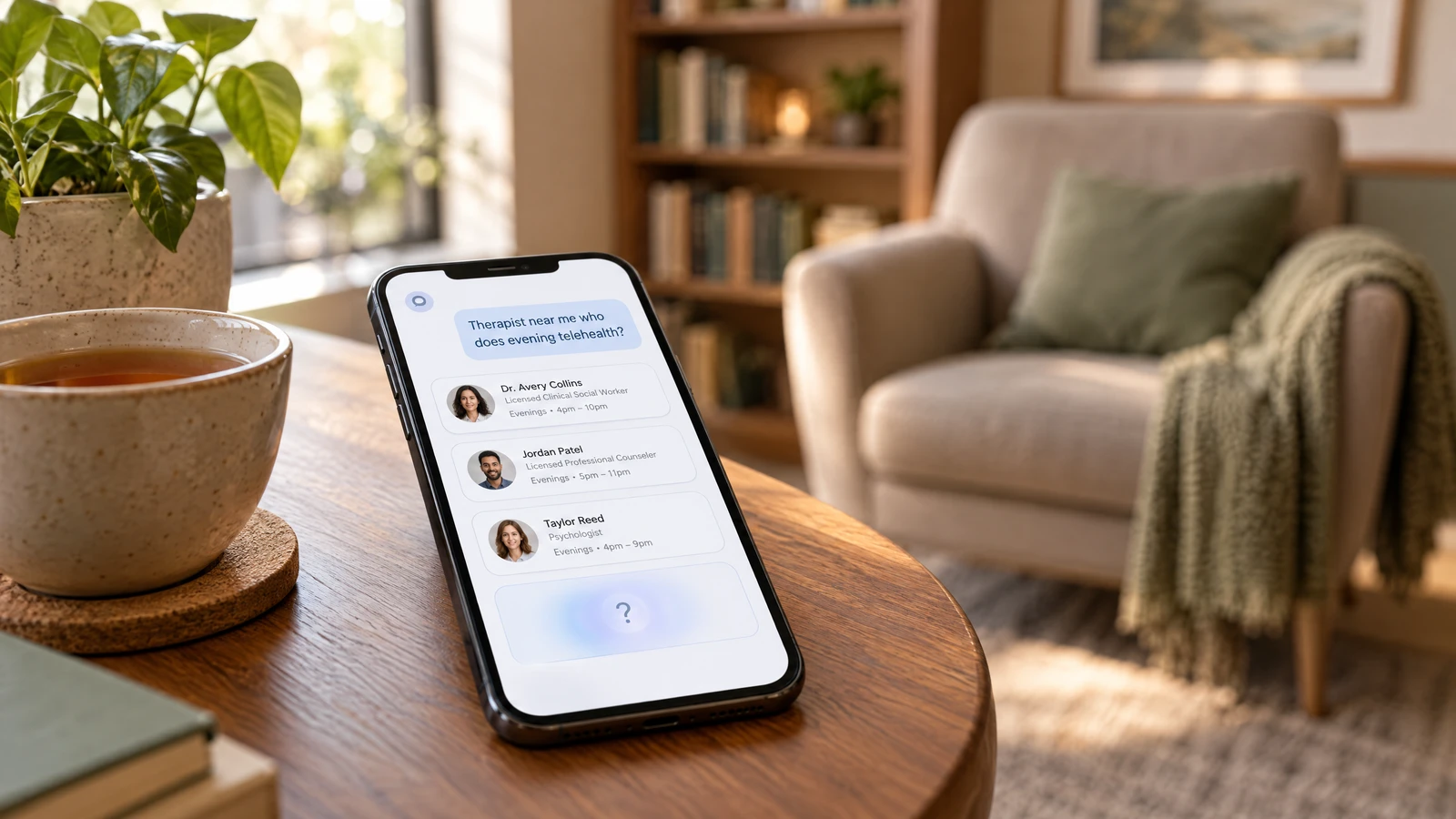
People don't only type "therapist near me" anymore. More and more, they write a full sentence into ChatGPT or Google's AI Mode: "I'm in Austin, my anxiety is getting worse, I want someone who takes Aetna and does evening telehealth." They get a short answer, often a handful of names, before they click anything.
If you're a therapist, that raises two fair questions. Where do those answers come from? And how do you show up in ChatGPT without paying someone to "hack" AI?
There's a lot of noise on this topic, much of it from people selling AI visibility packages. So this guide sticks to what Google, OpenAI, Perplexity, Anthropic and Microsoft say in their own documentation, and what that means for a private practice. Full disclosure: AI search visibility is one of the services we offer. Everything below, you can do yourself.
How ChatGPT and Google decide who to recommend
There are really two kinds of systems, and they work differently.
Google AI Overviews and AI Mode
Google is unusually direct about this. Its documentation says there are no extra requirements and no special optimizations needed to appear in AI Overviews or AI Mode. To be shown as a supporting link, a page has to be indexed in Google and eligible to appear with a snippet. That's it.
So if a page on your site isn't indexed in regular Google Search, it can't be a source in Google's AI answers either. Everything starts there.
ChatGPT, Perplexity, Claude and Copilot
The AI assistants run their own search systems, each with its own crawler:
- ChatGPT uses OAI-SearchBot. OpenAI says a site that opts out of it won't show in ChatGPT's search answers, though it can still appear as a plain link. So if you want to be found, don't block it.
- Perplexity uses PerplexityBot to surface and link sites in its results, and recommends allowing it.
- Claude uses Claude-SearchBot to index content for search. Anthropic says blocking it may reduce your visibility in Claude's search results.
- Microsoft Copilot answers are covered by Bing Webmaster Tools, which now has a report on how often your pages are cited (more on that below).
Here's the part most people miss. Each company also runs a separate crawler for training its AI models: GPTBot for OpenAI, ClaudeBot for Anthropic. Blocking those keeps your content out of future model training. OpenAI's documentation says each setting is independent, so you can allow OAI-SearchBot and block GPTBot. Those are two different switches, and you can set them differently.
Local questions work differently again
When someone asks for a therapist in a specific city, AI tools don't only read websites. OpenAI's help center says ChatGPT may share a general location with trusted third-party providers to get things like nearby business listings. In July 2026, Axios reported that Yelp is licensing its reviews, ratings, photos and business information to OpenAI for ChatGPT answers. And an independent study of local answers in ChatGPT, published in September 2026, found that it often cites third-party listing and review sites alongside its own results.
Google's own guidance for its AI features also tells site owners to keep their Business Profile information up to date.
For therapists, that means your Psychology Today profile, your Google Business Profile and your other listings are part of your AI visibility, not separate from it.
Step 1: Check you're not accidentally hidden
Before anything else, check that these tools can actually reach your site. It takes about 20 minutes, and it's the step most often broken without anyone noticing.
In Google Search Console: run URL Inspection on your homepage and your main specialty pages. Each should say it's indexed. Google has also added a "Search generative AI" control, a toggle that lets a site opt out of AI Overviews, AI Mode and AI features in Discover. Check that nobody switched it on by mistake.
In your robots.txt file: visit yourwebsite.com/robots.txt. You're looking for any "Disallow" line under Googlebot, Bingbot, OAI-SearchBot, PerplexityBot or Claude-SearchBot. If you see one and you didn't put it there on purpose, ask your web person to remove it. Google also says to make sure any CDN or hosting service you use isn't blocking crawlers.
If your site uses Cloudflare: Cloudflare now sorts AI crawlers into three groups: Search, Agent and Training. For new domains, Search stays allowed. Since September 15, 2026, settings that block AI training, including the older "Block AI bots" option, also block crawlers that do both search and training. Cloudflare's documentation doesn't say which crawlers those are, so it's worth a look under your security settings if anyone ever switched that option on.
In Bing Webmaster Tools: set it up if you haven't. You can import your verified site and sitemap straight from Search Console, so it takes a few minutes. Microsoft's AI Performance report lives here, and Copilot's citations show up in it.
On the pages themselves: make sure your key information is written as text on the page, not only inside images, sliders or a downloadable PDF. Google lists this in its own best practices, and the other systems read text the same way.
Step 2: Say clearly who you help
AI answers are built from sentences. Pages that state the facts clearly are much easier to use as a source than pages built around a slogan.
Compare these two openings:
The first one feels nice. The second one answers the exact question someone typed into ChatGPT. You can keep your warmth. Just make sure the facts are there too.
The facts worth stating on your site, in words:
- Who you work with (adults, teens, couples, families)
- What you help with, and your main approaches (CBT, EMDR, IFS)
- Where you see clients, and which states you're licensed in for telehealth
- Insurance you take, your fees, and whether you offer a sliding scale
- Your credentials and license type
- How to book, and how soon people can usually get in
Then go one level deeper. A short page for each main specialty, answering the questions clients ask before they book ("What happens in a first EMDR session?", "Can couples therapy help if only one of us wants to go?"), gives AI tools something specific to cite. We go further into this in our local SEO guide for therapists, and the same habits of clear credentials and plain claims show up in our piece on what Google looks for on a therapy site.
A note on structured data (schema): it helps search engines understand who you are, and it's worth having. But Google says there's no special schema or markup you need for its AI features. Standard schema for your practice and your clinicians is enough. Nobody needs a secret file.
Step 3: Get your listings right
Because local AI answers lean on listings, this is often where a practice gains the most for the least effort:
- Google Business Profile. Complete every field, especially categories, services and the description. Our local SEO service starts here too.
- Bing Places. Free, quick, and it feeds the Microsoft side.
- Apple Business. Apple is moving the tools from Apple Business Connect into a new platform called Apple Business. They control how your practice appears in Apple Maps and Siri.
- Yelp. Many therapists ignore it. Claim your free listing and make sure the details are right, since Yelp data is now licensed to ChatGPT.
- Psychology Today and other directories. These are some of the most-read pages about you, by people and by AI tools. Our Psychology Today profile tips walk through the details.
Keep your practice name, address, phone number and specialties the same everywhere. When sources agree, AI tools can be confident they're describing the right person.
Step 4: Be mentioned beyond your own website
AI tools tend to trust what several independent sources agree on. A practice that appears only on its own website is easier to overlook than one that's also mentioned elsewhere. That's a general pattern rather than something any of these companies documents, so treat it as a sensible bet, not a rule.
It's also the same reason many practices feel squeezed when large platforms dominate search, which we wrote about in how private practices still get found.
Ethical ways for a therapist to build that:
- Get listed with your professional association and any local referral networks
- Offer to be quoted by local news when mental health topics come up
- Guest on a podcast or write for a local parenting, wellness or professional site
- Speak at a school, library or community group, and ask them to link to your site on the event page
- Make sure your university, training institute or clinic affiliations list you correctly
None of this is fast. All of it also helps with regular Google rankings, word of mouth and referrals.
Four myths worth ignoring
"You need an llms.txt file." Google has said llms.txt files won't help or hurt in Google Search, including its AI features, and its documentation says you don't need new AI text files or markup. If you want one for other reasons it's harmless, but it's not where your time should go.
"Blocking AI training will keep you out of ChatGPT." No. Training crawlers and search crawlers are separate. You can opt out of training and still appear in answers.
"AI search needs a completely different strategy." Mostly, it doesn't. Google says there are no special optimizations for its AI features. The other tools' documentation is about access: letting their search crawlers in.
"Someone can guarantee you'll be recommended." Nobody controls what these tools say, and answers change from one question to the next. OpenAI says plainly that there's no way to guarantee top placement in ChatGPT search. Be wary of anyone promising a guaranteed spot.
How to tell if it's working
For the first time, there's some real data:
- Search Console, generative AI reports. Google now shows how often your pages appeared in its AI features, by page, country and device, over time. It shows impressions only, not clicks or the exact questions. Google says it reached all sites worldwide on August 31, 2026. If it looks empty for your site, there may simply not be much to show yet.
- Bing Webmaster Tools, AI Performance. Shows how often Copilot and Bing's AI summaries cited your pages, plus sample phrases the AI used when pulling your content. It's a public preview and doesn't include click data.
- Google Analytics. Look at your traffic sources for chatgpt.com, perplexity.ai, claude.ai, copilot and gemini. How ChatGPT tags its links has changed from time to time, so check the referral source rather than relying on one tag.
And once a month, test it yourself. Ask ChatGPT, Gemini, Perplexity, Copilot and Claude the same five questions and note the answers in a simple document:
- "Who are good [specialty] therapists in [your city] who offer telehealth?"
- "Find a therapist in [your city] who takes [your insurance] for [an issue you treat]."
- "What do you know about [your practice name]?" (check it's accurate)
- "Is [your name] a licensed therapist in [your state]?"
- A question one of your specialty pages answers, like "Is EMDR or CBT better for trauma?"
Answers vary from one try to the next, so don't read too much into a single result. You're watching for patterns over a few months: does your practice start appearing, and is what the AI says about you correct?
Quick checklist
Here's how to show up in ChatGPT, Google's AI and the rest, boiled down to one list.
- My main pages are indexed in Google (checked with URL Inspection)
- The Search generative AI control in Search Console hasn't opted my site out
- robots.txt doesn't block Googlebot, Bingbot, OAI-SearchBot, PerplexityBot or Claude-SearchBot
- If I use Cloudflare, I've checked the AI bot settings
- My site is set up in Bing Webmaster Tools with a sitemap submitted
- My homepage says clearly who I help, where, and how to book
- Google, Bing, Apple, Yelp and Psychology Today listings are complete and match
- I check the generative AI reports and my five test questions once a month
Not sure how your site looks to search engines and AI tools? Try our free website scorecard for therapists, or book a free 30-minute call and we'll look at it together. If you'd like help with the ongoing work, that's what our SEO, AEO and GEO service is for.
Frequently asked questions
Can I pay to be recommended by ChatGPT?
Nobody can guarantee a spot in AI answers. OpenAI says ranking in ChatGPT search depends on several factors and there's no way to guarantee top placement. Be cautious with anyone promising guaranteed placement.
Should I block AI bots to protect client privacy?
Your public website shouldn't contain any client information to begin with. Blocking training crawlers is a reasonable personal choice. Blocking search crawlers mostly just removes you from AI answers that could send you new clients.
Does my Psychology Today profile help with AI search?
Often, yes. Directories and review sites are among the sources AI tools commonly cite for local questions, so a complete, accurate profile helps people and AI tools describe you correctly.
How long does it take to show up in AI answers?
Fixing a blocked crawler can take effect within about a day for tools like ChatGPT and Perplexity, according to their documentation. Building clear pages, listings and outside mentions takes months, the same as regular SEO.
Is AI search replacing Google?
You don't have to choose. Google's AI features are part of Google Search, and the foundations that help you there also help with ChatGPT, Perplexity and the rest.
Do I need a separate AI SEO service?
Not necessarily. Most of this is good website and local SEO work done carefully. If someone pitches AI visibility as something completely separate from SEO, ask them what exactly they'd do differently.
Related services
- SEO for Therapists: Ongoing SEO, AEO and GEO: keep climbing every month
- AI Search Optimization for Therapists: be the practice AI recommends
Sources
- Google Search Central: AI features and your website (checked November 1, 2026) (opens in a new tab)
- Google Search Central blog: generative AI performance reports in Search Console (checked November 1, 2026) (opens in a new tab)
- Search Engine Roundtable: Google's Search Console AI report and AI control are live globally (checked November 1, 2026) (opens in a new tab)
- OpenAI: Overview of OpenAI crawlers (checked November 1, 2026) (opens in a new tab)
- OpenAI Help Center: ChatGPT search (checked November 1, 2026) (opens in a new tab)
- Perplexity: PerplexityBot documentation (checked November 1, 2026) (opens in a new tab)
- Anthropic: Does Anthropic crawl data from the web, and how can site owners block the crawler? (checked November 1, 2026) (opens in a new tab)
- Microsoft Bing: Introducing AI Performance in Bing Webmaster Tools, public preview (checked November 1, 2026) (opens in a new tab)
- Bing Webmaster Blog: import your sites from Google Search Console (checked November 1, 2026) (opens in a new tab)
- Axios: Yelp partners with ChatGPT to surface reviews (checked November 1, 2026) (opens in a new tab)
- Cloudflare: Block AI bots (checked November 1, 2026) (opens in a new tab)
- Search Engine Roundtable: Google on llms.txt files (checked November 1, 2026) (opens in a new tab)
- Apple: Introducing Apple Business (checked November 1, 2026) (opens in a new tab)
- APA: Ethical Principles of Psychologists and Code of Conduct, Standard 5.05 Testimonials (checked November 1, 2026) (opens in a new tab)
- Suff Digital: local business answers in ChatGPT (checked November 1, 2026) (opens in a new tab)